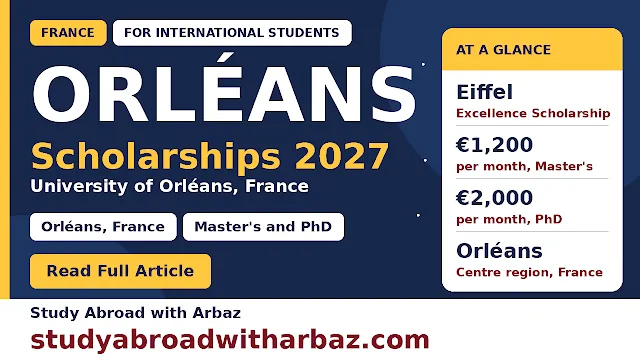
The University of Orléans scholarship route for international master's students in 2027 is the France Excellence Eiffel Scholarship, for which the university nominates candidates. Master's recipients receive €1,200 per month plus certain services, but the program does not pay tuition. You cannot apply to Campus France yourself. Send one complete PDF and one form to Orléans by Friday, November 13, 2026, at 23:59 (UTC+1). You must have been born after March 31, 1997, live outside France, and show B2 French unless you pick one of the two English-taught master's programs.
- Orléans nominates candidates. Files sent straight to Campus France or to a program director are rejected.
- The master's allowance is €1,200 per month. Tuition is not paid by the Eiffel program, although scholarship holders are exempt from national-diploma tuition at public institutions.
- The Orléans deadline is November 13, 2026, and results arrive in April 2027, so a separate admission application matters.
- Only two master's programs are taught entirely in English. Every other program needs proof of B2 French.
- Quick Facts
- What the Orléans Eiffel Route Actually Is
- Degree Levels and How Long Funding Lasts
- Eligible Master's Programs and Language of Instruction
- Eligible Nationalities
- Eligibility Rules and Who Is Excluded
- International Applicant Guidance
- For U.S. Applicants
- For Pakistani Applicants
- Documents and the Single PDF Rule
- What the Funding Covers and What You Still Pay
- Scholarship Application vs Admission Application
- How to Apply: The Official Five Steps
- Deadlines and Time Zones
- How Candidates Are Selected
- Mistakes That Lead to Automatic Rejection
- After You Are Selected
- Frequently Asked Questions
- Official Sources
- Disclaimer
Quick Facts
| Detail | Official information |
|---|---|
| Scholarship | France Excellence Eiffel Scholarship, nominated through the University of Orléans |
| Funder and manager | French Ministry for Europe and Foreign Affairs, managed by Campus France |
| Level covered here | Master's (M1 and M2) and Polytech Orléans engineering diplomas |
| Campaign | 2027-2028. The funded study period must begin between September 1 and November 30, 2027 |
| Monthly allowance | €1,200 (rate effective January 1, 2026), plus certain services |
| Funding length | Up to 24 months from M1, up to 12 months from M2, up to 36 months for engineering |
| Tuition | Not paid by the program. Scholarship holders are exempt at public institutions for national diplomas under French rules |
| Age limit | Born after March 31, 1997 |
| Nationality | Non-French only. Dual nationals holding French nationality are not eligible |
| Residence | Currently studying abroad. Students already enrolled in France are not eligible |
| Language | B2 French for French-taught programs. Two master's programs are taught in English |
| Orléans deadline | Friday, November 13, 2026, 23:59 (UTC+1) |
| Results | Announced in April 2027 |
| Funding type | Partial funding: monthly allowance plus services, not a full cost-of-study package |
What the Orléans Eiffel Route Actually Is
The Eiffel program is a French government tool for attracting strong foreign students to master's and doctoral study. It works by nomination. French institutions choose the candidates and submit the files, and Campus France states that applications sent directly by students or by foreign institutions are declared ineligible.
At Orléans, that nomination step happens by email. The International Relations Department collects every master's file, the supervisor of the program you choose reviews it, and only candidates who are supported get invited to complete the full file on the Campus France platform. This matters because the real competition happens inside Orléans, weeks before Campus France sees anything.
If you are searching for a University of Orléans scholarship for 2027, this nomination is the one the university promotes on its international scholarship page. The same section lists separate UFA and UFI scholarship pages, which this guide does not cover. For the wider national picture of the program, see our Eiffel Excellence Scholarship guide.
Degree Levels and How Long Funding Lasts
The entry year you are admitted to decides how many months the scholarship can run. That changes the total value of the award more than most applicants expect.
| Entry point | Maximum funded months | Maximum allowance at €1,200 (illustrative) |
|---|---|---|
| Master 1 (M1) | 24 | €28,800 |
| Master 2 (M2) | 12 | €14,400 |
| Engineering diploma (Polytech Orléans) | 36 | €43,200 |
These totals are my own multiplication of the official monthly rate by the official maximum duration. They are ceilings, not promises. The allowance is paid from the date you arrive in France, and the regulation suspends it during a repeated year, an optional internship abroad, or a gap year.
Orléans also runs a doctoral component through supervisors. It follows different rules and is outside this master's guide.
Eligible Master's Programs and Language of Instruction
Orléans publishes a list of eligible programs for the 2027-2028 campaign. If your program is not on that list, the Orléans Eiffel route is not open for it. Program names below follow the official PDF, and the English glosses are mine.
| Faculty or school | Eligible programs (M1 and M2 unless noted) | Teaching language |
|---|---|---|
| Law, Economics and Management |
|
International Economics is taught in English. The others are taught in French. |
| Humanities, Languages and Social Sciences |
|
Languages, Business and International Management is taught in English. The others are taught in French. |
| Polytech Orléans (engineering school) |
|
French |
| Science and Technology |
|
French |
| Observatory of Sciences of the Universe (OSUC) |
|
French |
Orléans states that only two master's programs are taught entirely in English. Every other program on the list is taught in French, and applications without proof of at least B2 French will not be considered. If you do not hold a B2 certificate today, International Economics and Languages, Business and International Management are the realistic choices for this deadline.
One more point on fields. Campus France describes seven priority areas for the program, such as biology and health, ecological transition, mathematics and digital, engineering sciences, law and political science, and economics and management. Treat the Orléans list as the controlling document, because it already filters programs against those areas.
Eligible Nationalities
The Orléans page opens the program to applicants of non-French nationality. An applicant with dual nationality that includes French nationality is not eligible. The pages I checked do not publish a list of eligible or excluded countries.
There is one wording detail worth knowing. The program description says it encourages applications from students of emerging countries aged 29 or younger at master's level. That reads as an emphasis, while the formal eligibility rule only excludes French nationals. If you come from an industrialized country, apply with open eyes: the rule does not shut you out, but the program's stated focus points elsewhere.
Eligibility Rules and Who Is Excluded
| Rule | Requirement | Who is out |
|---|---|---|
| Nationality | Non-French | French nationals and dual nationals including French |
| Age | Born after March 31, 1997 | Anyone born on or before that date |
| Residence | Currently studying abroad | Students already enrolled in France |
| Other scholarships | No French government scholarship under another program at the time of application | Current holders, even of a social scholarship, as the page words it |
| Nominating institution | Submitted by one institution only | Candidates submitted by more than one institution |
| Route | Through the Orléans International Relations Department only | Files sent directly to Campus France or to a program director |
| French level | B2 proof for French-taught programs | Applicants without that proof |
| Completeness | All requested documents in one message | Incomplete files are not examined |
International Applicant Guidance
This opportunity is open to foreign nationals in general, but "international student" does not mean every situation qualifies. Check these points before you spend time on documents:
- Where you live matters as much as your passport. Master's applicants must be studying abroad now. A student already enrolled at a French institution is excluded, even with a non-French passport.
- Age is counted from a fixed date. Orléans converts the 29-year limit into a birth date, which is after March 31, 1997.
- Do not stack French funding. The regulation says an Eiffel scholarship may not be combined with another French government scholarship, an Erasmus+ scholarship, or an Agence Universitaire de la Francophonie scholarship. If you win two, you must decline one.
- Use local advice for admission. Campus France recommends contacting its office in your country or the French Embassy's cooperation department for guidance on study plans.
- Convert the deadline to your own time. The official time is France, UTC+1. See the deadline table.
For U.S. Applicants
Several parts of this process work differently for someone studying in the United States.
- Class ranking. Orléans asks for documents proving your ranking in your class, at least for last year, and says the file does better if you show rank across your whole academic career. Many U.S. universities do not calculate class rank. This is my practical suggestion, not an official rule: ask your registrar or department for a GPA percentile, an honors letter, or a statement of standing, and explain the situation in your cover letter.
- Transcripts. The file needs transcripts for the last three years, with an official translation if necessary. Ask your registrar for official PDF copies early, because campus offices slow down in November.
- Emerging-country emphasis. As explained in the nationalities section, the program description stresses emerging countries at master's level. The formal rule only excludes French nationals, so a U.S. citizen may apply, but you should weigh that wording honestly.
- Regular admission. Orléans directs applicants in countries with an Études en France center to apply through that platform between October 1 and December 31 (earlier in some countries). Our Campus France application guide notes that the United States is on the Études en France list. Confirm your own route on the Orléans international students page.
- Time zone. The deadline falls at 17:59 Eastern Standard Time or 14:59 Pacific Standard Time on Friday, November 13, 2026.
For Pakistani Applicants
- Two different deadlines, five days apart. The Eiffel file closes at Orléans on November 13, 2026, which is 03:59 on Saturday, November 14 in Pakistan. Our Campus France guide lists November 18, 2026 for the regular Études en France campaign in Pakistan. The scholarship date comes first, so do not plan around the later one.
- Ranking proof. Pakistani universities often do not print a class rank on transcripts. As a practical suggestion rather than an official rule, ask your department or examination office for a position certificate or a letter stating your standing, and keep it with your transcripts.
- Transcripts for the last three years. Prepare official transcripts that cover your most recent three academic years. The Orléans page asks for an official translation only "if necessary" and does not say whether English-language transcripts need one, so confirm before paying for translation.
- Attestation and equivalence. The Orléans Eiffel page does not list HEC attestation or IBCC equivalence in the scholarship file. They may still come up in later admission or visa steps, so do not let them delay your November submission.
- French or English-taught. Most Pakistani applicants will not hold B2 French yet. That makes International Economics and Languages, Business and International Management the practical options, unless you already have a B2 certificate.
Documents and the Single PDF Rule
Orléans asks for two attachments in one email: a single PDF containing your proof documents, and a separate form. Splitting the PDF into several files is a common way to get a file marked incomplete.
Resume
Your current resume, kept consistent with your transcripts.
Cover letter or professional project
A statement of your professional project. Our motivation letter guide can help you structure it.
Transcripts, last three years
With an official translation if necessary.
Ranking proof
At least last year's ranking. Rank across your whole academic career improves your chances, according to Orléans.
Eiffel application form
The Word form that Orléans provides on its Eiffel page, named NOM_Prenom_formulaire_EIFFEL.docx.
B2 French proof
Mandatory for every French-taught program. Not needed for the two English-taught programs.
Exact naming Orléans requires. Name the PDF LAST NAME_First Name_Justificatifs-M-Eiffel-UO and use the email subject Candidature LAST NAME First Name Bourse Eiffel UO. Send both attachments in a single message to bourse.eiffel@univ-orleans.fr. The Orléans page states no file size limit. If your email provider rejects a large PDF, shrink it with our PDF compressor and check that scans stay readable.
What the Funding Covers and What You Still Pay
This is partial funding. The allowance and services are valuable, but a scholarship holder still carries real costs. The table separates what the official regulation covers from what it does not.
| Item | Covered? | What the rules say |
|---|---|---|
| Monthly allowance | Yes | €1,200, paid from your arrival date in France, and only once you have started studies at your host institution |
| International airfare | Partly | Least expensive class, reimbursed on receipts up to 50% of the ministry's maximum rate for your country |
| Travel inside France | Yes, on receipts | Second-class train or bus from the arrival airport to your study location |
| Return flight | Yes, with conditions | Request within 12 months of the scholarship ending. It depends on submitting your final academic results and has the same 50% cap |
| Health insurance | Yes | Temporary plan arranged by Campus France until French social security starts. Supplementary cover follows at no cost once you send proof of enrollment |
| Housing | Help only | Campus France offers a place in a CROUS residence or private housing. Rent itself comes from your allowance |
| Tuition | Not paid by Eiffel | French government scholarship holders are exempt from tuition for national diplomas at public institutions. Orléans also says scholarship students are exempt. Extra fees specific to a faculty can still apply |
| Course fees | No | The program does not cover them |
| CVEC student contribution | Exemption for scholarship students | Orléans refers to proof of payment or, for scholarship students, exemption |
| Language training before the program | No | You pay for it. At most one month of benefits from August is possible if the training is stated in your application |
| French test, visa fees, document translation | Not stated | No official amount found in the pages I checked, so budget for them yourself |
An illustrative budget check. Suppose you enter M2 and receive the full 12 months. The maximum allowance is 12 x €1,200 = €14,400. Rent, food, local transport, your French test fee, visa costs, and the unreimbursed half of your airfare all come out of that sum or your own pocket. Assumption: no proration for a late arrival and no suspension. Check the current EUR exchange rate before converting.
Why the tuition rule looks contradictory
You will see sites say "tuition not covered" while others say scholarship holders pay nothing. Both come from the same regulation. The Eiffel program does not pay tuition as a line item. Separately, French law exempts holders of a French government scholarship from tuition for national diplomas at public institutions. Orléans repeats that scholarship students are exempt. Before you rely on it, ask Orléans to confirm your program carries no extra fee.
Scholarship Application vs Admission Application
The Eiffel nomination and your admission to the master's are two separate applications. Orléans warns that because Eiffel results come in April 2027, applicants who also want to be considered through regular admission must apply before the deadline of their chosen program.
| Question | Eiffel nomination | Regular admission |
|---|---|---|
| What it decides | Nomination for the scholarship | Your place in the program |
| Where you apply | Email to bourse.eiffel@univ-orleans.fr | Études en France in countries with a center, MonMaster for M1, eCandidat for M2, per the Orléans page |
| Timing | Closes November 13, 2026 | Études en France October 1 to December 31 (earlier in some countries), MonMaster March to April, eCandidat February to June |
| Result | April 2027 | After each program reviews your file |
The admission windows above come from the Orléans international students page, which still shows 2026-2027 registration details. Confirm the 2027-2028 dates for your program before you rely on them.
How to Apply: The Official Five Steps
Confirm your age, residence, nationality, and that your program is on the Orléans list. Secure B2 French proof if the program is taught in French.
Combine your resume, cover letter or professional project, three years of transcripts, and ranking proof into a single PDF with the required file name.
Complete the Eiffel Word form from the Orléans page.
Send them to bourse.eiffel@univ-orleans.fr with the required subject line before the deadline.
A complete file is examined by the program supervisor, who gives the final decision. If you are supported, Orléans contacts you to fill in the full Campus France file.
Deadlines and Time Zones
Orléans closes its internal selection on Friday, November 13, 2026, at 23:59 (UTC+1). The university states that no application is accepted after that date. Use our application deadline tracker to keep this date with your other applications.
| Time zone | Local time of the deadline |
|---|---|
| France (official, UTC+1) | Friday, November 13, 2026, 23:59 |
| UTC and UK (GMT) | Friday, November 13, 2026, 22:59 |
| U.S. Eastern (EST, UTC-5) | Friday, November 13, 2026, 17:59 |
| U.S. Pacific (PST, UTC-8) | Friday, November 13, 2026, 14:59 |
| Pakistan (PKT, UTC+5) | Saturday, November 14, 2026, 03:59 |
I calculated these conversions for the actual date. U.S. daylight saving time ends on November 1, 2026, so U.S. zones are on standard time on November 13. The official time always controls. Aim to send your email at least a day early so a mailbox problem does not cost you the application.
| Milestone | Date |
|---|---|
| Orléans internal selection closes | November 13, 2026, 23:59 (UTC+1) |
| Eiffel results | April 2027 |
| Funded study period must begin | Between September 1 and November 30, 2027. The start date cannot be postponed |
Campus France also runs a later national submission stage for institutions. As a student you only need the Orléans date.
How Candidates Are Selected
Orléans says the main criterion is academic excellence. A complete file is examined by the program supervisor, who gives the final decision on whether Orléans supports your application, and you are told by message. The university does not describe a scoring formula, interview, or number of places, so I will not invent one.
Two points follow from the official wording. First, your ranking evidence carries real weight, because Orléans says a ranking across your whole academic career improves your chances. Second, you are told not to contact any program supervisor, so the file itself has to make your case.
Mistakes That Lead to Automatic Rejection
- Sending your application directly to Campus France or to a program director.
- Being submitted by more than one institution.
- Leaving out any requested document, because incomplete files are not examined.
- Applying to a French-taught program without proof of B2 French.
- Holding French nationality, even alongside another one.
- Already being enrolled in France at master's level.
- Holding another French government scholarship at the time of application.
- Writing to program supervisors, which Orléans asks applicants not to do.
Beyond the official list, two small habits save time. Use the exact file name and email subject formats, and send the application with a few hours to spare rather than minutes.
After You Are Selected
- Enrollment. You must be officially enrolled at the institution that submitted your application. The scholarship is tied to the program and institution named in that application, and a change of program is only accepted inside the same field and at the same institution.
- Insurance. Campus France enrolls you in a temporary plan until French social security begins. You must send proof of social security coverage within two months of arrival, and payments can be suspended if proof is missing by the start of the third month.
- Housing. Orléans warns that CROUS cannot accommodate every student and encourages you to look for alternatives early.
- Registration. Orléans asks new students for a CVEC certificate or exemption before enrollment and for a pre-registration form completed before arrival. The procedure on the page I checked covers 2026-2027, so confirm the 2027-2028 version.
- What can end the scholarship. Signing an apprenticeship or professional training contract ends it automatically, and so does an internship in your country of origin. A repeated year, an optional internship abroad, or a gap year suspends it.
- Reporting. You send Campus France your enrollment certificate and academic progress forms each year, and publications from your studies must acknowledge the Ministry's support.
- Visa. Follow the long-stay student visa procedure for your country. Our Campus France guide explains the Pakistan sequence.
Frequently Asked Questions
Does the University of Orléans offer scholarships to international master's students for 2027?
The route the university promotes for the 2027-2028 campaign is the France Excellence Eiffel Scholarship, for which Orléans nominates master's candidates. The university's scholarship section also lists separate UFA and UFI scholarship pages, which this guide does not cover.
What is the University of Orléans Eiffel scholarship deadline for master's applicants?
Orléans closes its internal master's selection on Friday, November 13, 2026 at 23:59 (UTC+1) and says no application is accepted after that date. That is 22:59 UTC, 17:59 Eastern Standard Time, 14:59 Pacific Standard Time, and 03:59 on November 14 in Pakistan.
How much does the Eiffel scholarship pay at master's level?
The master's allowance is €1,200 per month at the rate effective January 1, 2026, plus certain services such as airfare reimbursement, domestic travel support, insurance, housing search help, and cultural activities. The program itself does not pay tuition or course fees.
Do I need to speak French to apply?
Only two master's programs on the Orléans list are taught entirely in English: International Economics and Languages, Business and International Management. Every other eligible program is taught in French and requires proof of at least B2 French, and files without that proof are not considered.
What is the age limit for the master's Eiffel scholarship at Orléans?
Master's applicants must be 29 or younger on the date of the selection committee, which Orléans defines as being born after March 31, 1997.
Can I send my Eiffel application directly to Campus France?
No. Every application must go through the International Relations Department of the University of Orléans, which forwards selected files to Campus France. Files sent directly to Campus France or to a program director are rejected, and so are candidates submitted by more than one institution.
Can I apply if I already live or study in France?
No for the master's level. Orléans states that only students currently studying abroad can apply, and students already enrolled in France are not eligible.
Do I still need a normal admission application if I apply for the Eiffel scholarship?
Yes, if you want to be considered for admission whatever the scholarship result. Eiffel results are announced in April 2027, so Orléans tells applicants to submit the regular admission application before the deadline of their chosen program.
Is the Eiffel scholarship fully funded?
It is better described as partial funding. The master's allowance and listed services help with living and travel costs, but the program does not pay tuition, and scholarship holders still budget for housing, food, and other costs from the allowance.
Official Sources
- University of Orléans: Application Eiffel Scholarship
- University of Orléans: Eligible programs for the 2027-2028 Eiffel campaign (PDF)
- Campus France: The France Excellence Eiffel scholarship program
- Campus France: Eiffel regulations (PDF)
- University of Orléans: Registration fees
- University of Orléans: International students application and registration
Disclaimer
This article is for educational and informational purposes. Deadlines, eligibility rules, funding amounts, and procedures can change. The details here were checked against the official University of Orléans and Campus France pages listed above on October 31, 2026. Study Abroad with Arbaz is not affiliated with the University of Orléans, Campus France, or the French government. Always confirm current details with the university and the official sources before you apply or make financial decisions. Read our full disclaimer.
Want More Scholarship Guides?
Follow Study Abroad with Arbaz for scholarship updates, admission guides, and step-by-step application tutorials.
Subscribe on YouTube Join WhatsApp Channel

We would love to hear your thoughts! Please leave a comment below and share what you think.