SpaceMed Erasmus Mundus Scholarship 2027: €1,400 Monthly for a 2-Year Master's Degree
SpaceMed stands for Physiology and Medicine of Humans in Space and Extreme Environments, a unique Erasmus Mundus Joint Master programme that brings together three European universities. If you have a background in life sciences, psychology, kinesiology, engineering, or medicine, and want to specialize in space physiology, this programme offers a world-class education with full financial support for around 20 students per year.
This guide covers the complete application process, eligibility requirements, document checklist, and time zone conversions for Pakistani, US, and other international applicants. I have verified each deadline and requirement against the official SpaceMed website and updated it for the 2027/2028 academic year.
|
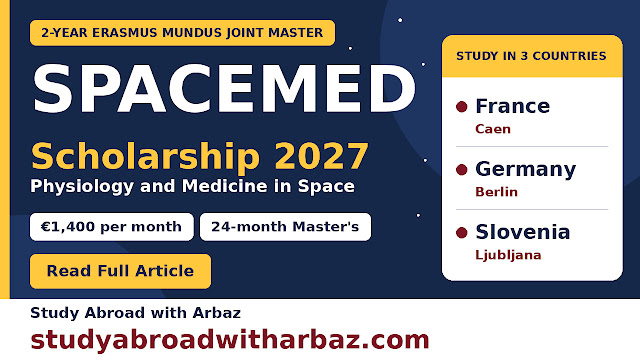
| SpaceMed allows students to study across three European universities in Germany, France, and Slovenia with hands-on space flight analogues |
| Detail | Information |
|---|---|
| Programme | Physiology and Medicine of Humans in Space and Extreme Environments (SpaceMed) |
| Degree | Master of Science (MSc) |
| Duration | 2 years (120 ECTS) |
| Funding | Fully Funded (Erasmus Mundus) |
| Monthly Allowance | €1,400 |
| Scholarships per Year | Up to 20 |
| Application Opens | October 21, 2026 at 8:00 AM CET |
| Scholarship Deadline | January 21, 2027 at 23:59 CET |
January 21, 2027 at 23:59 CET (about 4:59 AM PKT on January 22, 2027). This is the final deadline for scholarship applicants. Submit your complete application at least two days before the deadline to avoid technical issues.
- SpaceMed Programme Overview
- How to Win the SpaceMed Scholarship
- Who Can Apply (Eligibility)
- How Winners Are Selected
- Funding and Benefits
- Required Documents
- English Language Requirements
- Tuition and Additional Costs
- Application Procedure
- Deadlines and Time Zones
- Visa and Residence Permit
- For Pakistani Applicants
- For US Applicants
- For Other International Applicants
- After You Receive an Offer
- Common Mistakes to Avoid
- Scholarship Scam Warning Signs
- How to Apply Safely
- Frequently Asked Questions
- Final Words
- Official Links
SpaceMed Programme Overview
SpaceMed is an Erasmus Mundus Joint Master Degree coordinated by Charité – Universitätsmedizin Berlin in Germany, in partnership with Mednarodna podiplomska šola Jožefa Stefana in Slovenia and Université de Caen Normandie in France. The programme focuses on the physiological and medical challenges humans face in space and extreme environments, including high altitude, underwater, and extreme temperature conditions.
Students spend two academic years across the three consortium universities. The curriculum includes hands-on activities in state-of-the-art laboratories and field studies, such as parabolic flights, Antarctic habitats, experimental bed rest studies, and other space flight analogues. This multidisciplinary approach ensures that students gain practical experience in real-world extreme environment research.
The programme is accredited under the Erasmus Mundus framework, which guarantees high academic standards and automatic recognition of credits across the consortium. Funding comes from the European Commission through the Erasmus+ programme, covering participation costs and providing monthly stipends to scholarship holders.
How to Win the SpaceMed Scholarship
Competition for the 20 annual Erasmus Mundus scholarships is intense. Selection committees look for academic excellence, clear motivation, and the ability to succeed in a multidisciplinary scientific environment. A complete application that addresses every requirement stands out.
Meet the degree requirements
Confirm that you have a Bachelor degree in life sciences, psychology, or kinesiology (180 ECTS), a Master degree in engineering, a medical degree, or significant study in space or extreme environments.
Demonstrate B2 English proficiency
Aim for IELTS 6.5 or TOEFL 87 iBT to meet the minimum requirement. Higher scores strengthen your application, especially for competitive scholarship applicants.
Create a strong motivational video
Prepare a one-minute MP4 video that clearly explains your motivation and relevant skills. This video is a unique requirement for SpaceMed and counts toward your selection score.
Build relevant experience
Research or work experience in physiology, medicine, or extreme environments strengthens your application. SpaceMed values practical exposure to the field.
Who Can Apply (Eligibility)
Academic Requirements
Applicants must hold either a Bachelor degree in life sciences, psychology, or kinesiology (180 ECTS), a Master degree in engineering, a medical degree, or a degree characterized by significant study of humans in space or extreme environments. The degree must be recognized in all consortium countries: Germany, France, and Slovenia.
Academic Standing
Successful applicants must demonstrate academic excellence. The consortium evaluates applications based on several criteria: academic excellence (40 points), relevance of background to the field (15 points), quality of the degree-awarding institution (15 points), motivation (10 points), relevant work experience (9 points), letters of recommendation (8 points), and language skills (3 points).
Language Requirements
For English-taught tracks, you must demonstrate proficiency at B2 level on the Common European Framework of Reference for Languages. Accepted tests include IELTS (minimum 6.5), TOEFL (minimum 87 iBT, 237 computer-based, or 580 paper-based), and Cambridge English Qualifications B2 First. Test certificates must not be older than three years. Native English speakers are exempt but must provide a declaration on honour.
Previous EMJM Scholarship Rule
Applicants must never have been a beneficiary of an Erasmus Mundus Joint Master scholarship or Erasmus Mundus Master Course or Joint Doctorate scholarship. You must also undertake to waive any other EMJM scholarship for the duration of the SpaceMed course. No more than two nationals from the same country can be awarded a scholarship per intake.
Note: Meeting the minimum requirements does not guarantee selection. Use these thresholds as a starting point, not a target. Most scholarship holders exceed the minimum in both academic performance and language scores.
How Winners Are Selected
SpaceMed uses a competitive selection process based on a points system. Only applicants who meet all admission requirements and submit a complete application by the January 21 scholarship deadline are considered. Each eligible application is evaluated against the published criteria, with academic excellence carrying the highest weight at 40 points.
The final selection of scholarship recipients depends on ranking scores and geographic balance. The European Commission requires that Erasmus Mundus programmes maintain diversity in the nationalities of scholarship holders. This means that if many strong applicants come from the same country, not all can be selected, even if they have high scores. Additionally, no more than two nationals from the same country can receive a scholarship per intake.
The Admissions Board examines files from February to March 2027, and final selection results are announced by early April 2027. Self-funded applicants who meet the academic requirements may still be accepted after the scholarship round, subject to available places.
Funding and Benefits
Participation fee waiver
Scholarship holders pay no participation fees (€10,000 total for two years). The Erasmus+ programme covers this cost directly for EMJM scholars.
Monthly allowance
€1,400 per month for 24 months to cover accommodation, food, travel, and living expenses. This is the standard Erasmus Mundus unit cost.
Insurance coverage
Participation fees include health, liability, accident, and assistance insurance. Additional travel and visa costs are not covered.
No additional funding
SpaceMed does not allocate additional funding for travel, accommodation, or visa costs beyond the monthly allowance and insurance.
Important: Scholarship benefits are fixed by the Erasmus+ framework and may change between funding cycles. Confirm the exact allowance and coverage in the official call for applications before you plan your budget.
Required Documents
CV
A curriculum vitae, preferably in Europass format, outlining your education, work experience, and achievements.
Academic degree certificates
Original or certified copies of all higher education degrees completed to date. If you are still studying, provide transcripts of completed work.
Transcripts of records
Official transcripts with grades and credit points. If the original is not in English, provide a certified translation with a copy of the original document.
Proof of language proficiency
A valid test score report (IELTS, TOEFL, or Cambridge) or a medium of instruction certificate if applicable. The certificate must not be older than three years.
Two letters of recommendation
At least one must be from an official of the faculty where you obtained or will obtain your degree. The second can be from an employer, internship supervisor, or academic supervisor.
Motivational statement
A written statement explaining your interest in SpaceMed, your career goals, and why you are a strong candidate.
Motivational video
A short MP4 video (less than 1 minute) in English explaining why you would be a good candidate for SpaceMed, including personal and academic motivation and relevant skills.
ID document
A copy of a valid passport or national identity card. If you have dual nationality, upload both in a single PDF file.
Proof of residence
A document issued within the last 12 months showing your full name, exact address, and date of issue, such as a utility bill or official letter.
English Language Requirements
SpaceMed requires B2-level English proficiency. Accepted tests include IELTS (minimum 6.5), TOEFL (minimum 87 iBT, 237 computer-based, or 580 paper-based), and Cambridge English Qualifications B2 First. Test certificates must not be older than three years from the submission deadline.
If you have completed a previous degree entirely in English, you may submit a medium of instruction certificate from your university instead of a language test. This certificate must explicitly state that the medium of instruction was English for the entire programme. Request this document early, as universities can take several weeks to issue it.
Note: Native English speakers are exempt from taking a language test but must provide a declaration on honour. The OLS test is not accepted as a valid language certificate.
Tuition and Additional Costs
For self-funded students, the participation fees amount to €5,000 per year, or €10,000 for the two-year programme. Participation fees cover registration as a regular student at all universities, participation in teaching activities, student management and services, support in administrative and migratory procedures, and health, liability, accident, and assistance insurance.
Participation fees do not include visa costs, travel costs, individual module-related costs such as books and materials, or living expenses including accommodation. Scholarship holders have their participation fees directly covered by the Erasmus+ programme.
Tip: Use the CGPA calculator to convert your grades if needed, and track all deadlines with the scholarship deadline tracker.
Application Procedure
The flowchart below shows the complete application journey from checking eligibility to receiving the result. Follow each step in order and verify the official requirements before you proceed.
Verify that you have the required degree in life sciences, psychology, kinesiology, engineering, medicine, or significant space-related study. Confirm that you have never received an EMJM scholarship before.
Gather your CV, degree certificates, transcripts, language proof, recommendation letters, proof of residence, and ID document. Record your motivational video and ensure it is under one minute.
Register on the SpaceMed application platform from October 21, 2026. Select "All campaigns" then "Application EMJM SpaceMed," complete the forms in English, and submit before the January 21, 2027 deadline.
Deadlines and Time Zones
| Applicant Category | Deadline (PKT and ET) |
|---|---|
| Scholarship applicants | January 21, 2027 at 23:59 CET (4:59 AM PKT, 5:59 PM ET) |
| Self-funded applicants | January 21, 2027 at 23:59 CET (4:59 AM PKT, 5:59 PM ET) |
Submit your application at least two days before the deadline. Portal slowdowns near the closing time are common, and late submissions are rarely accepted. Convert the deadline to your local time zone and set reminders.
Visa and Residence Permit
After receiving an offer, you will need a student visa or residence permit for your first country of study. Each consortium country has its own requirements. Typical documents include a valid passport, the offer letter, proof of funding (the scholarship award letter), health insurance, and a criminal background check.
Visa processing times vary by country. Germany and France may take 4 to 8 weeks, while Slovenia can process faster. Apply for your visa as soon as you receive the admission letter to avoid delays. The consortium provides guidance on administrative and migratory procedures, but the visa application is your responsibility and additional costs are not covered.
For Pakistani Applicants
Pakistani students must provide attested copies of their degrees and transcripts from the Higher Education Commission (HEC) and, where applicable, the Inter Board Coordination Commission (IBCC). If your documents are in Urdu, they must be translated into English by a certified translator and notarized. Schedule HEC attestation well in advance, as this process can take several weeks.
For the language requirement, Pakistani universities that teach in English can issue a medium of instruction certificate. Contact your university registrar early to request this document. If you take IELTS, aim for a band score of 7.0 or higher to comfortably meet the 6.5 minimum. Use the IELTS band score calculator to understand your score.
Tip: If you need help writing your statement of purpose, use the motivation letter word counter to check length and ensure you stay within any specified limits.
For US Applicants
US applicants with a Bachelor degree in life sciences, psychology, or kinesiology (180 ECTS) may meet the degree requirement. If you hold a Master degree in engineering or a medical degree, you are also eligible. However, the US education system differs from the European ECTS system, so you should verify degree equivalence with the consortium.
Most US universities teach in English, so a medium of instruction certificate is usually straightforward to obtain. If you submit TOEFL scores, ensure they are recent and meet the B2 equivalent. For the visa process, US citizens do not need a Schengen visa for short stays, but a student residence permit is required for stays longer than 90 days in any consortium country.
For Other International Applicants
Applicants from countries outside the European Union are eligible for Erasmus Mundus scholarships and are strongly encouraged to apply. The geographic balance rule means that no single country can receive more than two scholarships per intake, which benefits applicants from underrepresented regions.
Check whether your country has specific document requirements, such as apostille certification or embassy legalization. Some countries require that degree certificates be verified by a designated authority. Start this process early, as international document verification can take months. Proof of residence must be issued within the 12 months preceding the submission deadline.
After You Receive an Offer
If you are selected for a scholarship, you will receive an official award letter by email. This letter confirms your funding, your study locations, and the steps you must take to accept the offer. Respond within the deadline specified in the letter, which is typically a few weeks after notification.
Before you travel, you may need to complete pre-departure requirements such as health insurance enrollment, accommodation arrangements, and registration with your first host university. The consortium provides guidance but does not cover travel or accommodation costs. You must take the initiative to secure housing and prepare for your move.
Note: Keep copies of your award letter, admission documents, and all correspondence. You will need these for visa applications, border entry, and the first payment of your monthly allowance.
Common Mistakes to Avoid
- Submitting incomplete applications: All documents, including the motivational video, must be uploaded by the deadline. Incomplete files are not considered for scholarships.
- Using expired language scores: Check the validity period of your test score. It must be valid at the time of submission and cannot be older than three years.
- Missing the video requirement: SpaceMed uniquely requires a one-minute motivational MP4 video. Record this early and ensure it clearly explains your motivation and skills.
- Ignoring the mobility rule: Previous EMJM scholarship recipients are ineligible. Confirm you have never received an Erasmus Mundus scholarship before.
- Missing the time zone: The deadline is in Central European Time (CET). Convert it to your local time and submit well before the cutoff.
Scholarship Scam Warning Signs
- Guaranteed selection: No legitimate committee can guarantee a scholarship. Selection is competitive and merit-based based on the points system.
- Payment for application forms: The SpaceMed application platform is free to use. Never pay a fee to submit your application.
- Unofficial email domains: Official communications come from space-med.eu or consortium university domains. Be cautious of messages from free email services.
- Requests for passport scans or bank details: Legitimate scholarship processes do not ask for sensitive financial information during the application stage.
How to Apply Safely
Apply only through the official SpaceMed application platform at space-med.eu. The official website is space-med.eu. Do not share your personal information with third-party agents who claim to secure scholarships for a fee. Erasmus Mundus scholarships are awarded directly by the consortium based on merit, not through intermediaries.
Important: If you receive an email that appears to be from SpaceMed but asks for payment or personal financial details, verify the sender domain and contact the official SpaceMed team through the contact form on their website.
Final Words
SpaceMed offers a unique opportunity to study space physiology and medicine across three European universities with full financial support. The key to success is to verify your eligibility against the official requirements, submit a complete application well before the January 21, 2027 deadline, and demonstrate clear motivation through both your statement and video. Whether you are from Pakistan, the United States, or any other country, the geographic balance rule means that scholarships are distributed globally.
Take the time to prepare your documents carefully, record a compelling motivational video, and secure strong recommendations. Apply only through the official SpaceMed platform to avoid scams. If you have questions about the application process, check the official website or review the related articles below for additional guidance on studying in Europe.
Frequently Asked Questions
Is the SpaceMed scholarship open to Pakistani students?
Yes, Pakistani students are eligible to apply for SpaceMed Erasmus Mundus scholarships. The programme is open to applicants from all countries, provided they meet the academic and language requirements. Geographic balance rules ensure that no single country receives more than two scholarships per intake, which benefits international applicants.
What is the deadline for SpaceMed Scholarships 2027?
The scholarship application deadline is January 21, 2027 at 23:59 Central European Time (CET). This is about 4:59 AM Pakistan Standard Time (PKT) on January 22, 2027, and 5:59 PM Eastern Time (ET) on January 21, 2027. Submit your complete application at least two days before the deadline to avoid technical issues.
Is an English test always required?
An English test is required unless you provide a medium of instruction certificate proving that your previous degree was taught entirely in English. The certificate must be issued by your university and explicitly state the language of instruction. Native English speakers are exempt but must provide a declaration on honour.
Can I apply without an agent?
Yes, you must apply directly through the official SpaceMed application platform. There is no fee to apply, and no agent is required. The selection process is conducted by the consortium based on your submitted materials. Be cautious of anyone claiming to guarantee selection in exchange for payment.
What degree level is required for SpaceMed?
SpaceMed requires a Bachelor degree in life sciences, psychology, or kinesiology (180 ECTS), a Master degree in engineering, a medical degree, or a degree characterized by significant study of humans in space or extreme environments. If you are still studying, you may apply if you are close to graduation.
How much is the monthly allowance?
Erasmus Mundus scholarship holders receive a monthly allowance of €1,400 for the duration of the 24-month programme. This amount is intended to cover accommodation, food, travel, and living expenses. The exact amount is set by the Erasmus+ framework and may change between funding cycles.
Read More Articles
- GEM Erasmus Mundus Scholarship 2027
- GLOBE Erasmus Mundus Scholarship 2027
- EMMIR Scholarship 2027 Erasmus Mundus
Official Links
Official Website https://space-med.eu/
Application Portal https://www.space-med.eu/apply-to-spacemed/application-procedure
Admission Criteria https://www.space-med.eu/apply-to-spacemed/admission-criteria
Ready to Apply for SpaceMed Scholarships 2027?
Review the official programme information, verify your eligibility, and submit your application through the authorised portal before the January 21, 2027 deadline.
Apply Now Official Website Subscribe on YouTube Join WhatsApp ChannelEditorial note: Scholarship figures, programme structure, and admissions details should always be checked against the official sources before an applicant submits.
Published:October 29, 2026
Last verified: October 29, 2026
Published by: Study Abroad with Arbaz


We would love to hear your thoughts! Please leave a comment below and share what you think.