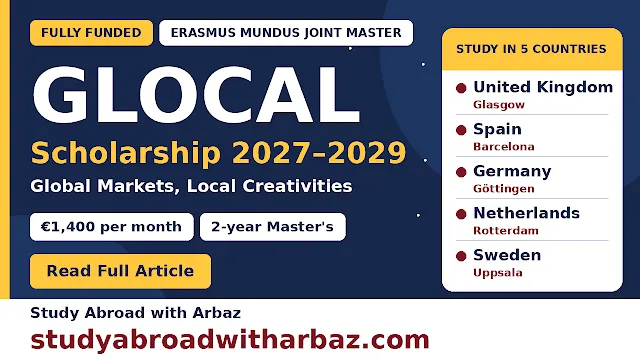
GLOCAL Erasmus Mundus Scholarship 2027 funds a two-year international master's degree that you complete in at least three countries. The scholarship deadline is January 14, 2027, at 1:00 PM UK time, which is 6:00 PM in Pakistan and 8:00 AM Eastern Time. It covers tuition, insurance, and a monthly allowance of €1,275 or €1,400, and students from any country can apply.
GLOCAL Erasmus Mundus Scholarship 2027: Deadline & Funding
This scholarship is for graduates with a strong social science or humanities background who want a funded master's in Global Markets, Local Creativities. The program is run by seven universities, and you apply once, through the University of Glasgow's online system. Your next step is to check the academic rules, pick one study track, and start collecting documents now, because the English test and the two references are what usually take the longest.
I wrote this guide for readers in Pakistan, the United States, and everywhere else. It adds a deadline conversion table, a document checklist, an arithmetic check on the allowance, and separate sections for Pakistani, US, and other international applicants. On October 29, 2026, I read the consortium's scholarship, how-to-apply, entry-requirements, visa, and FAQ pages, the University of Glasgow program page, and the Erasmus+ eligible-countries page. Everything below is written in my own words from those pages.
The GLOCAL Erasmus Mundus Joint Master's is taught across partner universities in Europe, Japan, and Colombia.
Quick Facts
These are the details most readers look for first. Each one comes from an official page listed at the end of this guide.
| Detail | Information |
|---|---|
| Program | Erasmus Mundus International Master in Global Markets, Local Creativities (GLOCAL) |
| Degree level | Master's, full-time, 2 years (24 months) |
| Intake covered | September 2027 entry |
| Where you study | Three partner universities from a consortium of seven, located in the UK, Spain, Sweden, the Netherlands, Germany, Japan, and Colombia |
| Language of teaching | English |
| Funding | Tuition, insurance, and a monthly allowance |
| Monthly allowance | €1,275 (Option One) or €1,400 (Option Two) |
| Scholarship deadline | January 14, 2027, 1:00 PM UK time |
| Results | April 2027 |
| Who can apply | Students of any nationality who meet the academic rules |
| Where to apply | University of Glasgow online application system |
| Study tracks open for 2027 | A, B, C, D, E, F, G, and I (Track H is not recruiting) |
- Overview
- Who Can Apply
- How Winners Are Selected
- Funding and Benefits
- Required Documents
- English Language Requirements
- Costs
- Application Procedure
- Deadlines and Time Zones
- Residence Permit or Visa
- For Pakistani Applicants
- For US Applicants
- For Other International Applicants
- After You Receive an Offer
- Common Mistakes
- Scam Warning Signs
- How to Apply Safely
- Frequently Asked Questions
- Final Words
- Official Links
- Read More
Overview
GLOCAL stands for Global Markets, Local Creativities. It is an Erasmus Mundus Joint Master's degree, co-funded by the European Union, that looks at how cities, firms, and creative industries stay competitive in a global economy. Seven universities teach it together: Glasgow, Barcelona, Uppsala, Rotterdam, Göttingen, Kyoto, and Universidad de Los Andes in Bogotá.
You do not spend two years on one campus. Most students start in Glasgow (Track I students start in Göttingen), move to Barcelona or Uppsala for the second stage, and then choose a third location, which depends on the track. The consortium's FAQ adds that Tracks C and G spend their whole second year in Bogotá. Every student gets one language class in Glasgow in the first semester as part of tuition.
Your diploma depends on the track. Some tracks award a jointly conferred degree from Glasgow and Barcelona plus a national master's from a third partner, while others combine Glasgow, Uppsala, and a third partner. Read the award line on the official program overview page for your track before you finalize your choice.
Study tracks at a glance
You can apply to only one track, and the consortium will not advise you on which one suits you best. This table is my plain-language summary of the official track list.
| Track | Partner universities | Focus |
|---|---|---|
| A | Glasgow, Barcelona, Rotterdam | Global history and creative industries |
| B | Glasgow, Barcelona, Göttingen | Global markets and development |
| C | Glasgow, Barcelona, Los Andes | Sustainable business development |
| D | Glasgow, Barcelona, Kyoto | Industrial dynamics and global business |
| E | Glasgow, Uppsala, Rotterdam | Institutional change and creative industries |
| F | Glasgow, Uppsala, Göttingen | Global political economy |
| G | Glasgow, Uppsala, Los Andes | Sustainability: institutions and management |
| I | Göttingen, Barcelona, Glasgow | Entrepreneurship in global markets |
Track H (international relations and sustainable development) exists on the official page but is not recruiting for 2027. If you are comparing tracks, look at where your thesis supervisor will be based, because the official page ties each track to a supervising university.
Who Can Apply
This section covers only the rules that decide whether you can apply. How the committee ranks eligible candidates is a different question, and I cover it in the next section.
Academic background
The consortium asks for a strict 2:1 UK Honours degree or an international equivalent. Accepted subject areas include anthropology, business, economics, global studies, history, international relations, liberal arts, literature, philosophy, political science, psychology, sociology, sustainability, trade, and urban studies. Social policy counts only at the master's level.
The list is a guide, not a guarantee. Your personal statement has to make the case that your studies fit the track you chose. If you are unsure how your grades convert, try my CGPA calculator first, then check the University of Glasgow's country-specific entry page, which the consortium points to for GPA rules.
- Tracks B, F, and I (Göttingen): at least a quarter of your studies, or 60 ECTS credits, must be in economics, business, modern history, economic and social history, sociology, or politics, alone or combined.
- All tracks: you may apply to one track only.
Conditions that apply to the scholarship
- You must hold a conditional or unconditional offer from the University of Glasgow.
- Your file must be complete at the deadline. A status of "holding for documents" means you will not be considered.
- You must not have received an Erasmus Mundus Joint Masters scholarship before.
- Your English language proof must be submitted by the scholarship deadline.
- If you hold more than one nationality, you must choose one to apply under.
- There is no age limit.
Still studying? Final-year students can apply on the strength of their latest transcript. You would receive a conditional offer first, and an unconditional offer only after your final degree result reaches Glasgow through your online application.
Nationality and the scholarship pools
Erasmus Mundus scholarships can go to students from any region of the world. To keep the geography balanced, no more than 6 regular scholarships per nationality are awarded across the four editions of the project, which is 10 percent of the 60 regular awards. In addition, the consortium has funding for up to 20 extra scholarships aimed at certain regions, and the 10 percent cap does not apply to those. Later sections explain what this means for Pakistani, US, and other applicants.
How Winners Are Selected
Selection is separate from eligibility. Once Glasgow confirms that you meet the entry rules, the consortium scores your scholarship file against four published criteria.
| Criterion | Weight | How I read it |
|---|---|---|
| Personal statement | 40% | The biggest single score, so it deserves the most editing time |
| Academic merit | 30% | Your grades and the strength of your degree |
| Quality of references | 10% | Specific, recent letters from people who know your work |
| Other | 20% | Relevant research, professional experience, awards, and similar evidence |
How the review works
According to the consortium's FAQ, two academic staff members score every eligible application in a first round. The top-scoring applicants are then reviewed by all seven partner universities and discussed at a final selection meeting. The result is a ranked list, and awards go to the top of it. The consortium does not release feedback or individual ranking positions.
Results, reserve list, and appeals
Results are due in April 2027, and every scholarship applicant is told by email. The consortium also keeps a reserve list in ranking order and contacts the first eligible name if an awardee withdraws. If you believe the selection procedure was defective or unfair, you have 14 days from the date of the decision to appeal. Send the appeal to socpol-glocal@glasgow.ac.uk with the subject line "GLOCAL scholarship appeal" and explain your reasons clearly.
What the personal statement must cover
The limit is 1,200 words, and the consortium asks you not to repeat yourself. In my reading of the official guidance, a strong statement answers these questions:
- Why this program, and how does it build on your earlier studies and future career?
- Why are you a good fit for the courses in both years?
- If you have worked since graduating, how does that experience connect to the program, and why are you returning to study?
- What might your thesis topic be? It can change later.
- Which conferences, internships, summer schools, civic work, or awards show your commitment, even if they are not directly about global markets?
Use my motivation letter word counter to stay under the limit, and read my guide on how to write a winning motivation letter for structure ideas.
Funding and Benefits
The scholarship is built from four parts. Think of them as separate lines in your budget, because each one is paid or provided in a different way.
Full tuition coverage
The scholarship and the consortium together cover tuition, including the deposit. The consortium states that recipients are not liable for any tuition fees.
Insurance coverage
The consortium lists full insurance coverage as part of the award. An older FAQ entry says the policy covers emergency healthcare but not trip cancellation.
Subsistence allowance
You receive a monthly allowance for the whole two-year program, at either €1,275 or €1,400 depending on your payment option.
Travel and installation
An optional contribution helps with visas, residence permits, and temporary housing. You get it only if you pick Option One.
Choosing a payment option
After you accept the scholarship, you indicate your choice in the pre-arrival welcome pack. The two options are designed to pay the same total.
| Detail | Option One | Option Two |
|---|---|---|
| Advance payments | €1,000 in August before semester one, €1,000 in May (end of Year 1), and €1,000 in September (start of Year 2) | None |
| Monthly allowance | €1,275 | €1,400 |
| Total over 24 months (my arithmetic) | €33,600 | €33,600 |
| Who it may suit (my view) | Students who need cash early for visas and flights | Students who prefer a steady monthly budget |
What the numbers add up to
The consortium deducts the three advance payments from the overall award, which is why the monthly figure under Option One is lower. If you multiply €1,275 by 24 months and add the €3,000 in advances, you reach €33,600. Multiplying €1,400 by 24 months gives the same total. This is my own calculation from the official figures, not an official total, and I have not converted it to US dollars or Pakistani rupees because exchange rates change daily. Use a live converter on the day you plan your budget.
What the scholarship does not cover
The University of Glasgow states that students, funded or not, pay their own airfares between partner universities. The official pages also do not publish a living-cost estimate for each city, so I cannot give you a verified figure. Plan for flights, visa fees, and housing deposits, especially in the first months, and ask current students through the consortium's student blog about real costs.
Required Documents
Every file goes through the online portal. The consortium does not accept applications or supporting documents by email, and you do not need to send hard copies.
Forms and CV
- The GLOCAL scholarship application form (the self-funded form is a different document).
- A CV in any format. The consortium prefers the Europass format.
- Your supporting personal statement of up to 1,200 words.
References
You need two references, and the rules are strict enough that I recommend sharing this list with both referees.
- At least one must be academic. A professional reference is allowed only if two academic ones are not possible, and it must come from an employer you worked for in the 12 months before applying.
- Each letter must be dated within 24 months of your submission date.
- Each must be on institutional letterhead or carry an official stamp.
- Each must carry a real signature, either handwritten or electronic. A typed name is not enough.
- Each must come from the referee's institutional email address, never a personal one. The referee can email erasmusreferences@glasgow.ac.uk directly (and you upload a note naming the sending address), or you can upload the letter yourself with the official email address shown on it.
Academic records
- Transcripts for every university-level study so far, in the original language and with an official English translation if needed. School-level records are not required.
- Degree certificates for every completed university-level degree, again in the original language with an official translation if needed.
Identity and English proof
- A color scan of the photo page of your current passport.
- Proof of English language ability, covered in the next section.
Good to know: You cannot enroll until all documents are received and you have accepted an unconditional offer. Scholarship applicants, however, must have their English proof in by the deadline.
English Language Requirements
Test rules and score scales change, and the University of Glasgow updates its list from time to time. This table reflects the Glasgow program page as I read it on October 29, 2026. Confirm every score on the official page right before you book a test or submit your application.
Applicants from countries that the UK government does not classify as majority English-speaking must show a minimum level of English. The requirement has to be met in a single test, and the test must have been taken within 2 years and 5 months of the program start. For a September 2027 start, that points to a test date no earlier than about April 2025, but confirm the exact start date with Glasgow.
| Test | Minimum score listed by Glasgow |
|---|---|
| IELTS Academic (including UKVI and online) | 6.5 overall, no subtest below 6.0. One-skill retake accepted. General Training is not accepted. |
| TOEFL iBT, taken up to January 20, 2026 | 90 overall, with Reading 20, Listening 19, Speaking 19, and Writing 21 |
| TOEFL iBT, taken from January 21, 2026 | 92 overall, no subtest below 4.5, as listed on the page |
| PTE Academic (test center only) | 65 overall, with Reading 60, Listening 60, Speaking 65, and Writing 60. The online version is not accepted. |
| Cambridge C1 Advanced or C2 Proficiency | 176 overall, no subtest below 169 |
| Oxford ELLT | 7 overall, no subtest below 6 |
| LanguageCert Academic | 70 overall, no subtest below 65 |
| Password Skills Plus | 6.5 overall, no subtest below 6.0 |
| Trinity ISE II | 96 overall, no subtest below 90 |
| Duolingo English Test | 120 overall, writing 120, no subtest below 110 |
Glasgow also lists Kaplan, PSI Skills for English, and the Oxford Test of English Advanced. Their score rules are on the official page. If you already have an IELTS result, my IELTS band score calculator helps you check whether your section scores average to the overall band you need.
Routes that replace a test
- Degree from a majority English-speaking country: you must have studied at least your final undergraduate year, or 9 months at the master's level, in that country, and finished the degree within 6 years of the program start.
- UK-awarded degree taught abroad: the degree must be awarded by the UK university and completed within 6 years of the start.
- Pre-sessional course: Glasgow accepts its own English for Academic Study pre-sessional and courses from a list of other universities. I could not confirm whether a pre-sessional result can meet the scholarship deadline, so ask Glasgow admissions before you rely on this route.
The Glasgow page does not list a medium-of-instruction letter as a way to meet the requirement. If your university offers one, treat it as unconfirmed and ask Glasgow admissions in writing.
Costs
If you win the scholarship, tuition is not your concern. The costs below matter mainly if you apply as a self-funded student or want to understand the value of the award.
Tuition fees for self-funded students
The University of Glasgow lists these tuition fees for the 2027-28 program. They cover tuition only, and Glasgow collects fees in pounds sterling.
| Fee category | Per year (GBP) | Per year (EUR) |
|---|---|---|
| UK, EU, and non-EU program countries | £9,750 | €11,255 |
| All other countries | £21,010 | €24,250 |
Applicants from Pakistan and the United States fall in the second row. The first row covers EU and EEA countries and associated countries such as Türkiye, because the European Commission's rules set those fees equal to UK fees for this program.
The deposit question
The University of Glasgow says all applicants must pay a £2,000 deposit to secure a place. The consortium's scholarship page says the award covers tuition, including the deposit. I could not reconcile the two from the pages alone, so ask Glasgow admissions how the deposit works for scholarship holders before you pay anything.
Costs you should still plan for
- Flights between partner universities.
- Visa and residence permit fees for each country you study in.
- Housing. The FAQ suggests booking Glasgow accommodation during the summer before you arrive, and notes that university-owned housing is not available to students who stay only one semester.
Application Procedure
The flowchart shows the full route in seven steps. The numbered steps below it explain what to do at each stage.
Compare your degree subject and grades with the accepted list, then choose the one track that fits your background.
Scan transcripts, certificates, and your passport page clearly, and ask both referees for letters that follow the rules above.
Book a test early enough for the result to arrive well before January 14, or confirm that your degree qualifies for a test-free route.
Open the application link from the official How to Apply page. When asked about funding, the consortium suggests choosing Other and typing "Erasmus Mundus Scholarship" in the extra information box.
Upload the GLOCAL scholarship application form with every supporting document. Submit before January 14, 2027, at 1:00 PM UK time, and keep the confirmation.
Glasgow admissions reviews your file first. If you meet the entry rules, the consortium then scores it for the scholarship, and you hear back in April 2027.
Everyone put forward for scholarship consideration receives an admission offer after the awards are announced. Accept the unconditional offer, then start your visa process.
Deadlines and Time Zones
The official deadline is written in UK time. In January the UK is on Greenwich Mean Time, so 1:00 PM in the UK is 1:00 PM GMT. The timeline below shows the key dates in order, and the table after it converts the deadline for readers around the world.
January 14, 2027, at 1:00 PM UK time for scholarship applications on all study tracks. That is a Thursday. All required documents, including English language proof, must be uploaded by then.
Deadline conversion table
I converted the deadline myself using standard time zone offsets for January. Pakistan does not use daylight saving time, and neither does India or the Gulf, so those offsets are fixed.
| Time zone | Time on January 14, 2027 |
|---|---|
| UK time (GMT, UTC+0) | 1:00 PM |
| Pakistan (PKT, UTC+5) | 6:00 PM |
| US Eastern (ET, UTC-5) | 8:00 AM |
| US Pacific (PT, UTC-8) | 5:00 AM |
| Central Europe (CET, UTC+1) | 2:00 PM |
| Gulf states (UTC+4) | 5:00 PM |
| India (IST, UTC+5:30) | 6:30 PM |
Scholarship deadline versus admission deadlines
Do not confuse the scholarship deadline with the self-funded admission deadlines. The scholarship date is the earliest and the one that matters for this guide.
| Application type | Deadline (UK time) |
|---|---|
| Scholarship, all tracks | January 14, 2027, 1:00 PM |
| Self-funded, Track D | January 14, 2027, 1:00 PM |
| Self-funded, Track I | June 14, 2027, 1:00 PM |
| Self-funded, Tracks A, B, C, E, F, and G (EU and international) | July 8, 2027, 11:59 PM |
| Self-funded, Tracks A, B, C, E, F, and G (Home and rest of UK) | August 24, 2027, 11:59 PM |
I suggest finishing your documents a week early and submitting at least two days before the deadline, because portal slowdowns near closing time are common. You can add the date to my scholarship deadline tracker so it stays visible.
Residence Permit or Visa
This program sends you through several countries, so you may need more than one visa or permit. The consortium says it is your responsibility to research each one and to apply early enough to start every mobility period on time.
The United Kingdom (first semester for most tracks)
Students on Tracks A to G who need a UK visa should apply for a Standard Visitor Visa. Those who do not need a visa enter as a Standard Visitor and obtain an Electronic Travel Authorisation. Both routes cover the semester in Glasgow. Because you will not hold a UK Student Visa, you cannot apply for the UK Graduate Visa afterward. Tracks H and I students can apply for a UK Student Visa for their full second year in Glasgow.
You can start your UK application once you have accepted an unconditional offer and received the Confirmation of Acceptance for Studies or the Standard Visitor Visa letter from Glasgow.
Spain and Sweden (second stage)
Under the new Schengen rules, you can apply for a study visa for any Schengen country up to six months before arrival. That means you can apply for a Spanish or Swedish visa from your home country, with Spanish applications going through the local Spanish embassy and Swedish residence permit applications going through the Swedish Migration Agency. The FAQ suggests Swedish and Spanish applications can begin around July.
Later mobilities and proof of funds
- Scholarship holders receive a Confirmation of Funding letter to support visa applications.
- EU citizens do not need a visa for Spain, Sweden, Germany, or the Netherlands, but they do need one for the third stage in Colombia, Japan, or the United Kingdom on Tracks C, D, G, and I.
- International students on Tracks B, F, and I may need extra health insurance to satisfy German entry rules, and the requirement can vary by nationality. Ask the University of Göttingen before you buy a private policy.
For Pakistani Applicants
Pakistani students are a core audience of this site, so this section focuses on what is specific to applying from Pakistan.
Which scholarship pool you compete in
Pakistan is listed in Region 5 (Asia) on the Erasmus+ eligible-countries page, and Region 5 is on GLOCAL's list of regions for the additional targeted scholarships. In practice, Pakistani applicants can be considered for both the regular scholarships and the extra ones. The consortium does not publish how many Pakistani students won in earlier editions on the pages I read, so I cannot tell you the odds.
References from the right email address
This is the rule I would double-check first. The consortium rejects references from personal email addresses, so a lecturer who normally uses a Gmail or Yahoo address must write from the university's own domain. Ask the department to issue the letter on letterhead with a stamp and a signature, and make sure it is dated within the last 24 months.
Transcripts, certificates, and grades
If your transcripts or degree certificates are already in English, you upload them as they are. Otherwise you also need an official English translation next to the original. The consortium does not list degree attestation as an application requirement, though an embassy may ask for it later, so check each visa office. To see how Glasgow treats your degree type, read its Pakistan page through the country-specific entry link in the official links section, and use my CGPA calculator for a first estimate.
English test planning
Pakistan is not on the majority English-speaking list, so most Pakistani applicants will need a test. IELTS Academic at 6.5 overall with no section below 6.0 is the benchmark, and a one-skill retake is accepted. Book early so your result arrives well before January 14, since the proof must be in your application at the deadline.
Deadline and visa timing
The deadline falls at 6:00 PM Pakistan time on Thursday, January 14, 2027. Treat the afternoon of January 12 as your own target. For travel, plan for a UK Standard Visitor Visa and at least one Schengen study visa, and confirm current rules with each embassy. I have not converted euros to rupees here, so check a live rate before you budget.
For US Applicants
A large share of this site's readers are in the United States, so here is what changes for you.
Which scholarship pool you compete in
The United States is listed in Region 12 on the Erasmus+ eligible-countries page. GLOCAL's list of targeted regions for the additional scholarships does not include Region 12, so by my reading, US applicants compete for the regular scholarships and fall under the cap of 6 per nationality across the four editions. GLOCAL points to an earlier edition of the Erasmus+ guide for its region list, so confirm the numbering on the guide page linked below.
Transcripts and degree evidence
Your documents are already in English, so you will not need translations. Ask your registrar early for official transcripts for every college you attended, including any graduate work, and request digital copies you can upload. Your referees should write from their .edu or other institutional address, because personal emails are refused.
English requirement
Many US applicants may be able to use the degree route instead of a test, because the United States appears on the UK government's majority English-speaking list. Check that list yourself, and confirm that your degree meets the study-period and 6-year rules described earlier. Even then, the scholarship deadline still requires your proof to be uploaded, so attach evidence of your degree rather than leaving the field empty.
Your deadline in US time
The deadline is 8:00 AM Eastern Time or 5:00 AM Pacific Time on Thursday, January 14, 2027. Treat Wednesday, January 13 as your real deadline, and finish your upload well before you go to bed that night.
Travel permissions
The consortium says travelers who do not need a UK visa should enter as Standard Visitors and obtain an Electronic Travel Authorisation. US citizens normally fall into that group, but confirm on the UK government website. For Spain and Sweden, a stay of a full semester generally goes beyond the short visa-free Schengen allowance, so check the study visa or residence permit rules with each country.
For Other International Applicants
If you are not from Pakistan or the United States, your situation depends mostly on your country's region and whether you hold an EU passport.
Which pool applies to you
The official scholarship page lists the regions targeted by the additional scholarships as Regions 1, 3, 5, 6, 7, 8, 9, 10, and 11. This table matches those numbers to the region names on the current Erasmus+ eligible-countries page. It is my reading of two official pages, so confirm your country on the guide itself.
| Group | What applies, by my reading |
|---|---|
| Regions 1, 3, 5, 6, 7, 8, 9, 10, 11: Western Balkans, South-Mediterranean, Asia, Central Asia, Middle East, Pacific, Sub-Saharan Africa, Latin America, Caribbean | Regular scholarships and the additional targeted scholarships |
| Regions 2, 4, 12, 13, 14: Neighbourhood East, Russia, US and Canada, small European states, and the Faroe Islands, Switzerland, and the UK | Regular scholarships only |
| EU member states and associated countries such as Türkiye | Regular scholarships. The Erasmus+ guide covers these countries as program countries, and self-funded fees match UK fees. |
Some countries also face restrictions under EU rules. The Erasmus+ guide has a section on this, so check it if your country might be affected.
If you hold two passports
You must choose one nationality at the application stage. The consortium's FAQ also says that if you applied as a partner-country applicant and also hold an EU passport, you can travel on the EU passport during the program, and you should tell the team at socpol-glocal@glasgow.ac.uk.
If you are an EU citizen
You do not need a visa for Spain, Sweden, Germany, or the Netherlands, though you may need to register with local authorities on arrival. On Tracks C, D, G, and I you will need a visa for the third stage in Colombia, Japan, or the United Kingdom.
If English is not your first language
Check whether your country is on the UK government's majority English-speaking list. If it is not, plan for a test from the table above, or confirm that you qualify for the degree route. Use the conversion table earlier in this guide to turn the deadline into your local time, and aim to submit a full day early.
After You Receive an Offer
An offer is only the beginning, and several steps follow in a fixed order.
Accepting your place
Everyone put forward for scholarship consideration receives an offer of admission after the results. You then accept the unconditional offer. If your offer is conditional on a final degree result or English proof, those documents must be with Glasgow before you can enroll.
Payments and paperwork
Choose your payment option in the pre-arrival welcome pack and request your Confirmation of Funding letter for visa applications. Keep copies of your offer letter, scholarship award, and every email from the consortium, because embassies and banks may ask for them.
Housing and arrival
Book accommodation in Glasgow during the summer, and start looking for second-stage housing shortly after the program begins. Glasgow's West End is close to the university, and the city center is a short subway ride away.
Common Mistakes
- Using a personal email for references: letters from Gmail or Yahoo addresses are refused.
- Submitting stale letters: references older than 24 months do not count.
- Sending a typed name instead of a signature: the letter must carry a handwritten or electronic signature.
- Missing English proof at the deadline: scholarship applicants must have it uploaded by January 14.
- Waiting too long for an offer: a status of "holding for documents" at the deadline ends your scholarship chances.
- Applying to several tracks: only one track is allowed.
- Emailing documents: the consortium does not accept them by email.
- Forgetting the scholarship form: without it, your file may not be considered for funding.
- Exceeding the word limit: the personal statement is capped at 1,200 words.
Scam Warning Signs
Popular scholarships attract fake agents and copycat websites. Watch for these signs:
- Guaranteed selection: the consortium ranks applicants and keeps a reserve list, so nobody can promise an award.
- Requests to send documents by email or chat: the official process uses the university portal only.
- Payments to unofficial accounts: pay only the university's own fees, through the official portal.
- Pressure to act today: real deadlines are published, so there is no need for secret urgent offers.
- Look-alike websites: official information lives on globallocal-erasmusmundus.eu and gla.ac.uk.
How to Apply Safely
Start from the official GLOCAL How to Apply page and follow its link to the University of Glasgow application system. Save the confirmation email and a screenshot of your submitted application. If something looks wrong, contact Glasgow's postgraduate admissions through its official inquiry form rather than a third party.
I cannot see or change your application, so questions about your file belong with Glasgow admissions. If you spot an error in this post, use the Contact Us page and tell me which line to check.
Frequently Asked Questions
What is the GLOCAL Erasmus Mundus Scholarship deadline for 2027?
The scholarship deadline for all study tracks is January 14, 2027, at 1:00 PM UK time. That is 6:00 PM in Pakistan, 8:00 AM Eastern Time, and 5:00 AM Pacific Time on the same date. Every required document, including your English language proof, must be uploaded by then.
How much does the GLOCAL Erasmus Mundus Scholarship pay?
The scholarship covers tuition, insurance, and a monthly allowance for the full two years. You choose between three advance payments of €1,000 plus €1,275 per month, or €1,400 per month with no separate advance payments. Both options add up to €33,600 over 24 months, which is my own arithmetic from the official figures.
Is there a separate application form for the GLOCAL scholarship?
You submit one application through the University of Glasgow's online system and attach the GLOCAL scholarship application form to it. There is no separate scholarship portal. The consortium suggests choosing Other as the funding option and typing Erasmus Mundus Scholarship in the extra information box.
Can Pakistani students apply for the GLOCAL scholarship?
Yes. The scholarship is open to students from any region, and Pakistan is listed in Region 5 (Asia) in the Erasmus+ Programme Guide, one of the regions targeted by the additional scholarships. The limit of 6 scholarships per nationality applies only to the regular scholarships.
Can US citizens apply for the GLOCAL scholarship?
Yes, scholarships can go to students from any region. The United States is listed in Region 12 in the Erasmus+ guide, which is not on GLOCAL's list of regions for the additional targeted scholarships, so US applicants compete for the regular scholarships.
Which English tests does the GLOCAL program accept?
The University of Glasgow accepts IELTS Academic with 6.5 overall and no subtest below 6.0, along with TOEFL iBT, PTE Academic (test center only), Cambridge C1 Advanced or C2 Proficiency, and several other tests. You must meet the requirement in a single test taken within 2 years and 5 months of the program start. Some applicants can use a degree taught in a majority English-speaking country instead.
Do I need an offer from Glasgow before I can receive the scholarship?
You must hold a conditional or unconditional offer from the University of Glasgow to be eligible. If your application status is holding for documents at the scholarship deadline, you will not be considered. You also must not have received an Erasmus Mundus Joint Masters scholarship before.
Can I apply to more than one GLOCAL study track?
No. You can apply to only one study track, and you must name it in your application. Track H is not recruiting for the 2027 intake.
When will the GLOCAL scholarship results be announced?
Results are due in April 2027, and the consortium's FAQ says early April. Every scholarship applicant receives an emailed decision. A reserve list is kept in ranking order in case an awardee withdraws.
Is the GLOCAL scholarship really fully funded?
It covers tuition, insurance, and a monthly allowance, which is what most people mean by fully funded, but the official pages do not use that phrase. The University of Glasgow notes that students pay their own airfares between partner universities. Plan for flights, visas, and housing costs that the allowance has to stretch across.
Final Words
If you remember only three things, make them these. First, check your degree against the accepted list and choose one track. Second, line up two correctly formatted references and your English proof well before January 14, 2027. Third, verify every number on the official pages, because rules and test scales change.
The funding is generous, but it is not a blank check, so budget for flights and visas from day one. If this guide helped, share it with a friend who is planning a master's in Europe, and let me know in the comments or through my Contact Us page what else you would like me to cover.
Official Links
These are the pages I used. Open them directly instead of relying on any summary, including mine.
- GLOCAL Erasmus Mundus Scholarship page
- GLOCAL How to Apply page
- GLOCAL scholarship application form 2027 (DOCX)
- Entry requirements and selection procedure
- Program overview and study tracks
- GLOCAL visa information
- GLOCAL frequently asked questions
- University of Glasgow program page (fees and English requirements)
- University of Glasgow admissions inquiry form
- University of Glasgow country-specific entry requirements
- Erasmus+ Programme Guide: eligible countries
Read More
If you are comparing Erasmus Mundus programs, these guides cover other options:
- GLOBE Erasmus Mundus Scholarship 2027
- EMMIR Erasmus Mundus Scholarship 2027
- GEM Erasmus Mundus Scholarship 2027
Ready to Apply for the GLOCAL Erasmus Mundus Scholarship 2027?
Read the official instructions, then submit your application through the University of Glasgow before January 14, 2027, at 1:00 PM UK time.
Open the Official Application Page Official Scholarship Page Watch on YouTube Join WhatsApp ChannelEditorial note: Scholarship amounts, dates, and rules can change. Always confirm them on the official pages before you submit. Read the site's disclaimer for more detail.
Published: October 29, 2026
Last verified: October 29, 2026, against the official pages listed above
Published by: Study Abroad with Arbaz


We would love to hear your thoughts! Please leave a comment below and share what you think.