Ibrahim Leadership Fellowship 2027 | $100,000 Stipend for African Leaders
Ibrahim Leadership Fellowship 2027: a 12-month paid placement for African professionals run by the Mo Ibrahim Foundation: three Fellows a year are placed with the African Development Bank in Abidjan, the UN Economic Commission for Africa in Addis Ababa, or the International Trade Centre in Geneva, with a US$100,000 stipend. You need African nationality, a master’s degree, at least seven years of work experience, and age under 40 (45 for women with children). Applications close 20 November 2026 , 11:59 PM Addis Ababa time: 3:59 PM US Eastern, 1:59 AM Pakistan time on 21 November.
Every year the Foundation puts three early-career leaders , one in Abidjan, one in Addis Ababa, one in Geneva , inside the institutions that shape African policy. The fellowship is not a degree and not a course: you join an executive office for 12 months, contribute to research and policy design, and finish the year with direct mentorship from the head of your host institution.
I checked the Foundation, AfDB, UN Careers, and UNECA notices on 23 October 2026 and kept the three hosts separate wherever their rules differ, because they do differ: document lists, submission routes, and even the published deadline details are not identical. There is no application fee at any stage, no agent in the process, and one date decides everything: 20 November 2026.
|
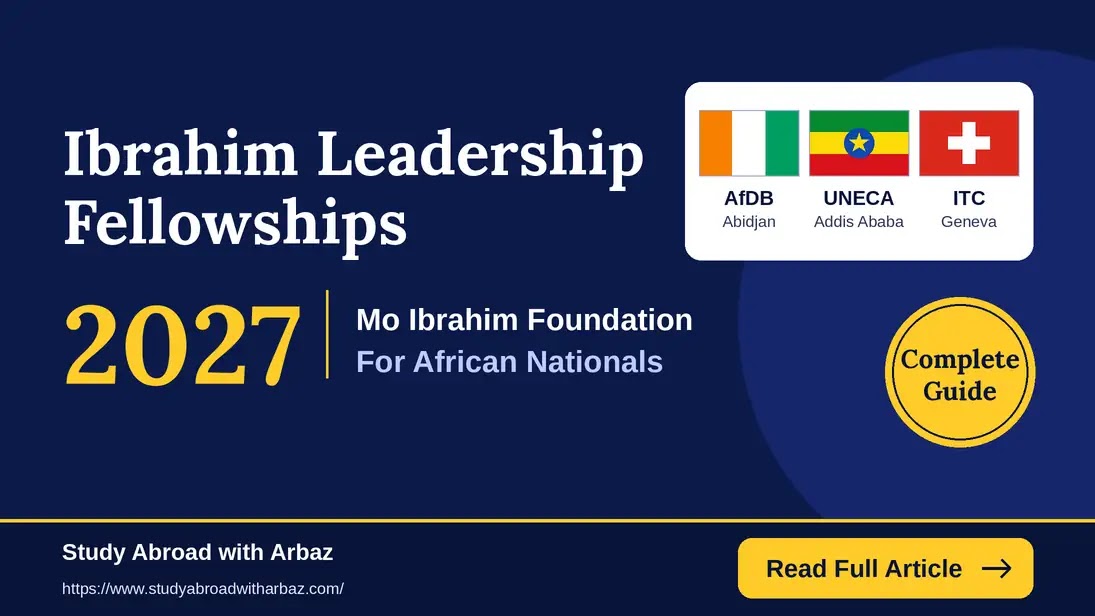
| The Mo Ibrahim Foundation’s Ibrahim Leadership Fellowships 2027: three 12-month placements at the AfDB, ECA, and ITC for African professionals |
Quick facts at a glance
| Detail | Information |
|---|---|
| Programme | Ibrahim Leadership Fellowships, run by the Mo Ibrahim Foundation |
| Places | 3 Fellows a year, one per host institution |
| Degree level | Master’s degree required; the fellowship itself is a work placement, not a taught programme |
| Experience | Minimum 7 years of relevant professional work experience |
| Age limit | Under 40; women with children may be under 45 (ECA measures age on the deadline date) |
| Nationality | National of an African country; you may be resident anywhere in the world |
| Host institutions | AfDB (Abidjan) · ECA (Addis Ababa) · ITC (Geneva) |
| Duration | 12 months (the ITC placement runs for one year from June 2027) |
| Funding | US$100,000 stipend for the 12 months, paid monthly through the host |
| Application fee | None , all three routes are free |
| Deadline | 20 November 2026 (11:59 PM Addis Ababa time for ECA; date-only for AfDB and ITC) |
| Selection | Shortlist of 10, then 3; only contacted candidates learn anything, and no result date is published |
| After the year | Fellows join the Foundation’s Now Generation Network of young and mid-career Africans |
20 November 2026 , ECA publishes 11:59 PM Addis Ababa time (GMT+3), which is 1:59 AM Pakistan time on 21 November, 3:59 PM US Eastern time, and 12:59 PM US Pacific time on 20 November. The AfDB and ITC notices state the same date without a clock time, so treat 20 November as firm for all three routes and plan to submit on 18 November rather than the final evening.
- Overview
- Who Can Apply
- How Winners Are Selected
- Funding and Benefits
- Required Documents
- Language Requirements
- Costs You Should Budget
- Application Procedure
- Deadlines and Time Zones
- Visa and Work Authorization
- For Pakistani Applicants
- For US Applicants
- For Other International Applicants
- After You Receive an Offer
- Common Mistakes to Avoid
- Scholarship Scam Warning Signs
- How to Apply Safely
- Frequently Asked Questions
- Final Words
- Official Links
- Read More
Overview
The Mo Ibrahim Foundation established the Leadership Fellowships in 2011 to put experienced young African professionals inside multilateral institutions, and the structure has stayed deliberately small: three seats a year, one per host. Since 2012 the programme has hosted 43 Fellows in total, including the 2026 cohort, and every one of them worked a full 12-month placement inside a senior office.
Fellows do not enrol in classes. Your days go to research, policy design, strategic assignments, and economic analysis alongside the host’s senior staff, and the programme adds leadership development around the job. The Foundation pays the stipend, the host supervises the work, and direct mentorship from the head of the institution is the feature the Foundation itself highlights as special.
African Development Bank
Strategic assignments, research, and policy work alongside the Bank’s leadership. The 2027 vacancy states that the final selection of the AfDB Fellow rests with the President of the Bank.
UN Economic Commission for Africa
Development policy, economic transformation, and governance work, contributing directly to research and policy design inside a UN regional commission.
International Trade Centre
Trade, small-business, and inclusive-growth projects, with mentorship from the ITC Executive Director and the Deputy Executive Director.
Exact focus is set by your host, but the areas Fellows contribute to across the three institutions are consistent:
- Economic development and economic transformation across the continent
- Trade, trade policy, and economic integration
- Governance, public policy, and international policy work
- Finance, financial analysis, and strategic planning
- Project management, research, and policy design
- Climate-resilient infrastructure and value addition to natural resources
2027 AfDB focus: the vacancy notice names four priorities Fellows may support , mobilizing resources for the continent, reforming the international financial architecture, the demographic dividend, and climate-resilient infrastructure plus value addition to natural resources. It also says the Bank favors applicants with private-sector experience and strong analytical skills in development policy.
The 2026 intake shows how varied the profile can be: Fadoua Mezgueldi from Morocco joined the AfDB with a background in impact finance, Malineo Masekepe Alina Seboholi from Lesotho, a government trade director, joined the ITC, and Keren Neza from Rwanda, a development economist, joined the ECA. The Foundation announced them on 30 April 2026, and none of the three followed a single academic track , which tells you what the selection actually weighs.
Who Can Apply
Two layers of rules apply: the Foundation’s baseline criteria for everyone, then whatever extra conditions your chosen host adds. Both layers are checked, so read them together before you prepare anything.
Baseline rules from the Foundation
- African nationality: you must be a national of an African country. Residence is irrelevant , you can apply from anywhere in the world, and your passport’s country is what counts.
- Master’s degree: a completed master’s degree before the programme starts; a bachelor’s alone does not qualify.
- Work experience: a minimum of seven years of relevant professional experience, which the Foundation frames as a mid-career profile, not an entry-level one.
- Age: under 40; the rule extends to 45 for women with children. The ECA notice measures age against the deadline date, 20 November 2026.
What the rules mean: meeting all four makes your file eligible for reading; it does not rank you. With three places and qualified applicants from a continent of 54 countries, the shortlist is decided on what your seven-plus years of work actually contain.
Extra rules set by each host
- AfDB: you must not be AfDB staff or a relative of staff, and the Bank excludes serving government officials, active military personnel, and political-party leaders. Nationality must be declared on the AfDB’s terms (single nationality accepted under the rules), and after the fellowship you may not be recruited as AfDB staff for one year. The notice also strongly encourages female candidates to apply.
- ECA: nationals of ECA member States, residing anywhere, who are not currently UN staff. Degrees in economics, business, international development, and related fields are welcomed, and age is assessed on the deadline date.
- ITC: African nationals holding a master’s in economics, business, international development, international relations, or a related field, with seven-plus years in international trade or trade-related development. The notice says priority may go to qualified African professionals without prior ITC experience, and it requires working English.
If you hold a second nationality that is not African, read the AfDB clause before choosing that host: its notice asks you to declare your nationality on a single-nationality basis, while ECA and ITC simply require African nationality. When in doubt, use the official contact printed in the vacancy before you invest a week in documents.
How Winners Are Selected
No host publishes a scoring formula, and none publishes a result date. The AfDB notice gives the most detailed sequence, so it is the best picture of what happens after you submit.
- Vetting: AfDB HR and technical reviewers screen every complete application for eligibility and fit.
- Shortlist of 10: the vetted shortlist goes to the Mo Ibrahim Foundation for its own review.
- Foundation recommendations: the Foundation returns its recommendations to the host institution.
- Three confirmed: three Fellows are selected , at AfDB, the final choice rests with the President of the Bank.
- Only shortlisted candidates are contacted: the notice says you hear from the Bank only if you are considered for an interview. Silence means your file was not shortlisted.
ECA promises an acknowledgment of receipt within one week for complete applications and contacts only finalists. ITC states that it will get in touch only when a candidate is under serious consideration. Neither publishes how many people apply, so there is no honest way to quote you an acceptance rate.
Important: matching every published criterion creates eligibility, not a ranking. Three institutions, three seats , the differentiator is the depth of your policy or trade experience and the strength of your three referee letters.
Funding and Benefits
The Foundation describes the package plainly: a stipend of US$100,000 for the 12-month programme. The rest of the value comes from the host institution and from the network you join at the end.
US$100,000 over 12 months
Paid monthly by the host institution from Foundation funds for the length of the placement , enough to live on in all three duty-station cities if you budget sensibly.
Direct mentorship of the head
The Foundation highlights one feature above all: Fellows benefit from direct mentorship of the heads of the host organisations , the AfDB leadership, the ECA Executive Secretary, or the ITC Executive Director.
Official travel covered
Under the AfDB and ECA terms, official mission travel and its insurance are covered by the host, and the Foundation covers travel to your duty station and repatriation.
Now Generation Network
On completion, Fellows become members of the Foundation’s Now Generation Network , young and mid-career Africans from all 54 African countries working on the continent’s development agenda. The ECA notice adds that the Foundation invites its Fellow to the Foundation’s annual Forum.
- Not a staff appointment: the fellowship is a funded placement, not employment. AfDB states there is no child-education support, no medical-insurance participation, and no retirement scheme, and ITC confirms Fellows do not participate in pension arrangements.
- One year, not renewable: the AfDB contract runs 12 months and is not renewable, and the one-year bar on AfDB recruitment applies after you finish.
- The stipend is for you alone: ITC’s notice states there are no dependant allowances and no work-permit support for family members.
- Paperwork before the start: ECA and ITC both issue a Letter of Award before commencement, AfDB issues its 12-month contract, and no host starts the placement without a written offer in hand , treat that document as your visa anchor.
Your own medical insurance, your dependants, and day-to-day costs before the first monthly payment stay your responsibility. Geneva in particular is an expensive city, and ITC is explicit that family costs are not covered , budget for the first month before you count on the stipend.
Required Documents
Each host publishes its own list, and the differences are small enough to be fatal at the formal screen. Build one folder with the common items, then add the quirks of your chosen route.
Curriculum vitae
AfDB asks for a comprehensive CV showing date of birth, nationality, education, and work experience; every host wants the seven-year track record visible at a glance.
Degree certificates and transcripts
AfDB requires academic transcripts; ECA asks for degree certificates and does not require bachelor’s documents for its route. Scans must be legible.
Three recommendation letters
AfDB: attach the three letters with your application. ECA: referees email the letters to you, and you submit them together , letters sent directly to ECA are not considered.
Profile or cover letter
ECA wants a UN Administrative Profile completed within its page limits inside the application email. Use our motivation letter word counter to keep any written statement tight.
Language statement
No host asks for a test certificate this cycle. State your languages in the CV or profile , ECA asks for fluency in English or French, ITC for working English.
Submission extras
ECA adds two of its own: a PDF copy of the online survey confirmation, and one complete email to RecruitmentPPost@un.org. Files must be PDF (zips allowed, no RAR), sent before the closing time.
Keep every scan readable but small , our free PDF compressor shrinks heavy files so a full ECA email package still sends cleanly on an ordinary connection. All three routes are free; nobody can sell you a slot, an upload, or a review.
Every document must be in your submission by 20 November 2026 , 11:59 PM Addis Ababa time for ECA, and the same date for AfDB and ITC. ECA states that late or incomplete applications are not considered, and it reviews only your most recent complete submission.
Language Requirements
No IELTS, TOEFL, PTE, or Cambridge certificate appears in any of the three 2027 notices, checked on 23 October 2026. Fluency is declared in your documents, then judged from the quality of your application and, if needed, an interview.
- ECA: fluency in English or French is required, other UN languages are desirable, and the application itself may be written in English or French.
- ITC: working English is required, with French or Spanish listed as desirable.
- AfDB: the vacancy is published in English (the Bank also operates in French), and your application should be in the language you work best in.
Note: for the 2027 cycle there is no test to book and no certificate to buy , spend that time on your documents instead. If a future notice asks for a certificate, this guide will say so, with the verification date at the top updated.
Costs You Should Budget
The stipend removes the money problem during the year, but three cost groups remain before and around it. The official notices define most of them.
| Cost item | Amount or responsibility |
|---|---|
| Application fee | None , AfDB, ECA, and ITC routes are all free |
| Stipend | US$100,000 for the 12 months, paid monthly through the host |
| Medical insurance, child education, retirement savings | Fellow’s responsibility (stated in the AfDB and ECA terms) |
| Family and dependants | Not supported , ITC states no dependant allowances and no family work permits |
| Travel to duty station and repatriation | Covered by the Foundation under the AfDB and ECA terms |
| Official mission travel and insurance | Covered by the host institution |
| Tuition or programme fees | Not applicable , this is a work placement, not a taught degree |
No currency conversion is printed in this guide on purpose: the stipend is a US-dollar figure and no local-currency amount is published, so convert on the day you build your budget. Abidjan, Addis Ababa, and Geneva have very different price levels , check a current cost-of-living guide for the city you are assigned to, not for the city you live in now.
One rule: there is no application fee, agent fee, or registration fee anywhere in this process. Any request for money , for any reason , is a scam, which is exactly what the AfDB notice says about payments of any kind.
Application Procedure
The flowchart below covers the full route from checking the baseline rules to starting the placement. The route you click differs by host, so the steps under it spell out all three submission paths.
African nationality, a master’s degree, seven-plus years of relevant work, and age under 40 , or under 45 if you are a woman with children. Age is measured on the deadline date.
Abidjan (AfDB), Addis Ababa (ECA), or Geneva (ITC). Choose the one where your seven years actually fit , each route is separate, and the Foundation’s fellowship page links all three.
Download it as a PDF and read the exclusions, the field requirements, and the document quirks. What AfDB demands and what ECA demands are close, but not the same.
CV with your full track record, degree certificates or transcripts, and three referee letters. Referees need time , approach them in October, not the week of the deadline.
AfDB: the online job-invite form. ITC: the UN Careers posting for job 285022, with a UN account and completed application. ECA: one email with every file attached, subject line “ECA 2027 Mo Ibrahim Leadership Fellowship (Last Name, First Name)”.
ECA closes at 11:59 PM Addis Ababa time; AfDB and ITC state the date only. Aim for 18 November, keep the confirmation, and never rely on the final hour.
AfDB vets internally, the Foundation reviews a shortlist of 10, and three names move on. Only candidates under serious consideration hear back, and no result date is published.
The Letter of Award or contract arrives first; use it for your entry paperwork, sort your own insurance, and travel to the duty station. The ITC placement year begins in June 2027.
Deadlines and Time Zones
The three notices were posted on 21 September 2026 and all fall due on 20 November 2026. Only ECA publishes a clock time, so the timeline treats 11:59 PM Addis Ababa time as the common shape of the deadline.
| Milestone | Official time | PKT | ET | PT |
|---|---|---|---|---|
| Application period opens | 21 Sep 2026 (date only) | , | , | , |
| ECA deadline (Addis Ababa) | 20 Nov 2026, 11:59 PM GMT+3 | 1:59 AM, 21 Nov | 3:59 PM, 20 Nov | 12:59 PM, 20 Nov |
| AfDB closing date | 20 Nov 2026 (no clock time published) | , | , | , |
| ITC closing date | 20 Nov 2026 (no clock time published) | , | , | , |
US clocks have already fallen back to standard time by 20 November 2026, so the Eastern and Pacific conversions above are EST and PST. Because only ECA publishes a closing minute, treat 20 November as the hard date for all three routes , nobody publishes a grace period, and none of the notices describes one.
Track the date with our scholarship deadline tracker alongside your other 2026–27 deadlines. Practical rule: finish on 18 November, keep your sent-mail confirmation, and never rely on the final evening. ECA reviews only the most recent complete submission and accepts no late files, and the other two hosts lose nothing by closing early.
Visa and Work Authorization
Three cities, three immigration systems: Côte d’Ivoire for AfDB, Ethiopia for ECA, and Switzerland for ITC. The programme notices do not publish embassy lists or processing times , that part is national law, and it is checked against the official immigration channels of the country you are assigned to.
- AfDB: the Bank issues a 12-month contract of employment to the selected Fellow, and you initiate the entry and work-authorization processes for Côte d’Ivoire on the strength of that document.
- ECA: a Letter of Award is issued before commencement; official mission travel and its insurance are covered during the year, while your entry permit and your own medical insurance remain your side of the deal.
- ITC: the Geneva placement runs one year from June 2027, and the notice states that no work-permit support is provided for family members or dependants.
If you are applying from outside your home country , as many African professionals in the diaspora do , the nationality rule still governs: apply as a national of an African country, from wherever you currently live. Start the moment the written offer arrives, because processing times vary by nationality and embassy, and official mission travel during the programme never replaces an entry visa.
For Pakistani Applicants
The Ibrahim Leadership Fellowships are not open to Pakistani nationals. The Foundation’s rule is African nationality, all three host notices repeat it, and residence elsewhere never substitutes for nationality , this is a continent-specific leadership programme, not a general international fellowship.
If you hold dual nationality that includes an African country, check each host’s clause before you choose: the AfDB notice requires you to declare nationality on a single-nationality basis, while ECA and ITC simply ask for African nationality. When the clauses conflict with your situation, email the host’s official contact printed in the notice and ask before you spend a week assembling documents.
Pakistani readers with a master’s degree and seven-plus years of policy, development, or trade work should look at wider Commonwealth routes instead , our Commonwealth Scholarship 2027 guide covers deadlines, eligibility, and documents for Pakistani applicants. And remember the standing rule of this programme: nothing here costs money, so any Pakistani “consultant” selling Ibrahim Fellowship seats is running a scam.
Tip: nationality questions are the one thing worth asking early. One email to the official contact in October can save you from building a complete file for a route that was never open to you.
For US Applicants
African nationals living in the United States apply on exactly the same terms as candidates on the continent: the rule is nationality, not location. Your US-based degree and experience are an asset , all three hosts value policy, finance, and trade work done in American institutions, and nothing in the notices hints otherwise.
Time is the only US-specific factor. With ECA’s deadline at 11:59 PM Addis Ababa time, the same moment reads 3:59 PM on the East Coast and 12:59 PM on the West Coast on 20 November 2026, because US clocks are already on standard time by then. AfDB and ITC publish date-only deadlines, so treat 20 November as firm in every US time zone rather than hunting for a closing hour that was never posted.
US citizenship or a green card does not help , without an African nationality you are not eligible for any of the three routes. If you do hold dual African nationality, read the AfDB single-nationality clause before choosing that host, keep scanned transcripts ready (all three routes accept scans from abroad), and plan consulate appointments for Côte d’Ivoire, Ethiopia, or Switzerland the moment your Letter of Award or contract arrives.
For Other International Applicants
African professionals in Europe, the Middle East, Asia, and elsewhere in the diaspora are squarely in scope: AfDB, ECA, and ITC all state that you may be resident anywhere in the world. You submit from your current country , AfDB through its online job invite, ITC through the UN Careers posting, ECA by email , with no in-person step before selection.
Watch two things from abroad: clocks and language. An 11:59 PM Addis Ababa deadline lands late at night in Europe and after midnight across South and East Asia, so submit a day early; and both ECA and ITC judge language fit from your application itself , working English everywhere, French valuable at ECA , rather than from a certificate you can buy at short notice.
One discipline worth adding: cross-check every date against your local clock before you rely on it, and keep confirmations. ECA acknowledges complete files within one week and reviews only the most recent submission, so a corrected package must land before 20 November, not after. Applicants who are not African nationals have no route here, and the honest advice is to use our other fellowship guides instead of forcing this one.
After You Receive an Offer
A selection message is the start of paperwork, not the start of the fellowship. Work through these steps in order , the order is the same at all three hosts.
- Get the written offer first. ECA and ITC issue a Letter of Award before commencement, AfDB issues its 12-month contract, and no placement starts without one of those documents in hand.
- Begin the entry paperwork. Use the offer to start work-authorization processes for Côte d’Ivoire, Ethiopia, or Switzerland from your current country , never wait until you land.
- Sort travel and insurance. The Foundation covers travel to the duty station and repatriation under the AfDB and ECA terms, while your own medical cover has to be arranged before you fly.
- Plan for the first month. The stipend is monthly, so budget for housing deposits and living costs in a new city before the first payment arrives , Geneva especially.
- Deliver during the year. The placement is judged by what you contribute: research, policy design, and assignments your host actually uses.
- Use the mentorship actively. Direct access to the head of the institution is the feature the Foundation highlights , prepare real questions instead of ceremonial ones.
- Keep the network afterwards. Fellows join the Now Generation Network on completion, a coalition spanning all 54 African countries; at AfDB, remember the one-year recruitment bar after the programme.
Note: keep every document , offer letter, contract, receipts, insurance papers , in one folder. You will need them for visas, banking, and any future employer who wants to verify the year.
Common Mistakes to Avoid
- Mixing up host document lists: sending ECA’s package to AfDB or vice versa. The lists look similar and differ in exactly the places that cause formal rejection.
- Referees writing directly to ECA: those letters are not considered. They must reach you by email first, and you submit them in one package.
- Missing an ECA extra file: the survey confirmation in PDF, the correct subject line, and every attachment in a single message , completeness is checked before content.
- Applying in the last hour: ECA accepts no late files and reviews only the most recent complete submission; the other two hosts publish no grace period at all.
- Miscounting your age: the check runs against the deadline date of 20 November 2026, not your next birthday.
- Applying to AfDB from excluded groups: serving government officials, active military personnel, and political-party leaders are out, whatever else your CV shows.
- Treating it as a staff job: no pension, no benefits schemes, one year, not renewable , plan your next move from month one.
- Paying anyone: there is no legitimate payment of any kind in this process; see the warning section below.
Scholarship Scam Warning Signs
- Any request for money or bank details: the AfDB notice states plainly that the Bank never asks applicants for payments of any kind, and no host has an application fee.
- Guaranteed selection: three seats exist and the host’s leadership decides them; nobody , consultant, agent, or insider , can guarantee a place.
- Agents collecting applications: all three routes are self-serve: a website form, a UN Careers application, or one direct email. There is no authorized intermediary anywhere.
- Lookalike email domains: ECA correspondence runs through RecruitmentPPost@un.org; anything else should be checked line by line against the official UNECA notice.
- Urgency in direct messages: official deadlines are published on official sites, and no selector contacts you on social media to “apply now or lose your seat.”
- Free mail domains: official contacts come from afdb.org, un.org, uneca.org, and mo.ibrahim.foundation , never from a generic mail provider.
Important: the fellowship is free, start to finish. If anyone asks for money , for any reason , it is not the Foundation, the AfDB, the UN, or the ITC. Stop, and report the contact through the official channel listed in the notice.
How to Apply Safely
Use only the routes in the Official Links section below: the Foundation’s fellowship page, the AfDB vacancy and its job-invite form, the UN Careers posting for ITC, and the UNECA PDF with its email instructions. Open them yourself from this page or by typing the addresses , never through an ad, a forwarded message, or a direct message claiming to be a selector.
- Check the domain in the address bar before you upload anything: afdb.org, careers.un.org, uneca.org, mo.ibrahim.foundation.
- Never send documents to individuals who approach you first, no matter how official their title sounds.
- Use the support contacts printed in the notices , AfDB’s HR Direct contact, ECA’s technical-support address in the notice (kassahunb@un.org) , rather than any third-party “help desk.”
- Keep submission receipts: the sent-mail copy for ECA, the confirmation page for AfDB and ITC, until the outcome is announced.
- Report payment requests to the host’s official contact; these institutions publish anti-fraud statements precisely because impersonation happens.
Frequently Asked Questions
What is the Ibrahim Leadership Fellowship 2027?
It is a 12-month paid placement programme from the Mo Ibrahim Foundation that puts three African professionals each year into the executive offices of the African Development Bank in Abidjan, the UN Economic Commission for Africa in Addis Ababa, or the International Trade Centre in Geneva, with a US$100,000 stipend. Applications for the 2027 cycle close on 20 November 2026.
How much does the Ibrahim Leadership Fellowship pay?
The Foundation provides a stipend of US$100,000 for the 12-month programme, paid monthly through the host institution. Official mission travel and travel insurance during the year are covered by the host under the AfDB and ECA terms, while your own medical insurance and living costs before the first payment remain your responsibility.
Who can apply for the Ibrahim Leadership Fellowship?
Nationals of African countries with a master's degree, at least seven years of relevant work experience, and who are under 40 on the deadline date , or under 45 if you are a woman with children. Each host adds extra conditions; the AfDB, for example, excludes serving government officials, active military personnel, and political-party leaders, and asks for a single-nationality declaration.
What is the deadline for the 2027 Ibrahim Leadership Fellowship?
All three routes are due on 20 November 2026. UNECA publishes 11:59 PM Addis Ababa time (1:59 AM Pakistan time on 21 November, 3:59 PM US Eastern and 12:59 PM US Pacific on 20 November), while the AfDB and ITC notices state the date without a clock time.
Final Words
Three seats, one deadline, zero fees , that is the whole shape of this opportunity. Check the four baseline rules, pick the host where your experience actually fits, and build your documents with your referees in October rather than in mid-November, because three letters take longer than any online form.
Everything here was checked against the Foundation, AfDB, UN Careers, and UNECA notices on 23 October 2026. If a page changes after that date, the official links below win over any summary, including mine , and the verification date at the top tells you when this guide was last fresh.
If the fellowship does not fit your profile this cycle, keep it on your list: the rules rarely move, and your seventh year of experience arrives sooner than you think.
Official Links
Foundation overview: Ibrahim Leadership Fellowships at the Mo Ibrahim Foundation
Applications open (news): Applications open for the 2027 Ibrahim Leadership Fellowships
AfDB vacancy: 2027 Mo Ibrahim Foundation Leadership Fellowship Program at AfDB
AfDB application form: AfDB job invite 2343 (external application portal)
ITC vacancy: UN Careers job 285022 , Mo Ibrahim Fellowship Opportunity at ITC
ECA notice (PDF): 2027 MIF Fellowship Programme notice from UNECA
ECA information page: UN Economic Commission for Africa fellowship page
Foundation news: 2026 Ibrahim Leadership Fellows announced from Morocco, Lesotho, and Rwanda
Read More
- Emirates Leadership Initiative Fellowship 2027
- How to Write a Winning Motivation Letter
- SDU Danish Government Scholarship 2027
Ready to Apply for the Ibrahim Leadership Fellowship 2027?
Pick your host, read its vacancy notice, and send a complete, fee-free application before 20 November 2026.
Open Application Routes AfDB Vacancy Subscribe on YouTube Join WhatsApp Channel Follow on LinkedInEditorial note: Stipend amounts, eligibility rules, and deadlines in this guide were checked against official Mo Ibrahim Foundation, AfDB, UN Careers, and UNECA notices on 23 October 2026. Host institutions can change their notices at any time, and selection outcomes are decided by the hosts, so confirm anything time-sensitive before you submit.
Published: 23 October 2026
Last verified: 23 October 2026
Published by: Study Abroad with Arbaz
Disclosure: This guide is independent. It is not affiliated with, or endorsed by, the Mo Ibrahim Foundation, the African Development Bank, the United Nations, or the International Trade Centre.
About us: About Study Abroad with Arbaz · Contact us · Disclaimer · Privacy policy


We would love to hear your thoughts! Please leave a comment below and share what you think.